Emilie Burnham, Astrophysicist
“Science makes people reach selflessly for truth and objectivity; it teaches people to accept reality, with wonder and admiration, not to mention the deep awe and joy that the natural order of things brings to the true scientist.” ― Lise Meitner

I am a PhD candidate in Astronomy and Astrophysics at Penn State University, where I study galaxy formation and evolution under the supervision of Dr. Joel Leja. My research focuses on using statistical inference and machine learning to understand the physical properties of galaxies from their spectra, both as individual systems and as entire populations.
This work is driven by a new generation of astronomical surveys. Space-based observatories such as the James Webb Space Telescope (JWST) allow us to probe the earliest galaxies during cosmic dawn, while next-generation ground-based instruments such as the Prime Focus Spectrograph (PFS) will provide an unprecedented view of galaxy evolution during cosmic noon. To meet the challenges posed by these large datasets, I develop accelerated software tools that enable astronomers to efficiently infer the histories and physical properties of millions of galaxies.
I am a member of the PFS Galaxy Evolution (GE) collaboration. With its remarkable multiplexing capabilities, PFS GE will obtain spectra for more than half a million galaxies spanning roughly six billion years of cosmic time. As part of the low-redshift working group, I help develop the data pipeline that will fit these observations and create large catalogs of stellar population properties, enabling new studies of galaxy evolution on a population-level scale.
A central focus of my research is understanding the burstiness of star formation in high-redshift galaxies. In particular, I am interested in how we can quantify this behavior and designing future JWST surveys capable of measuring this robustly.
Outside of astronomy, I enjoy spending hours experimenting in the kitchen, reading books far too large to in my bag, and writing stories of my own.
Selected Publications
-
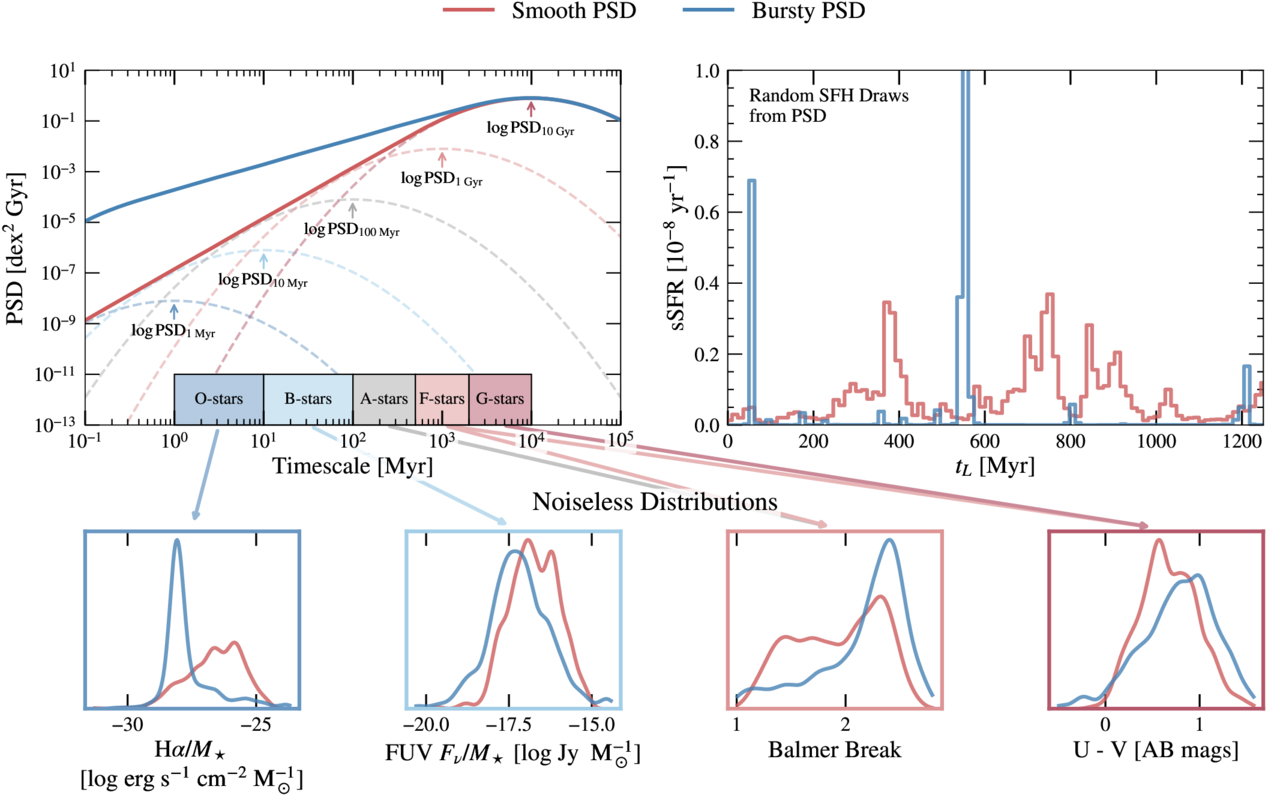
Effect of the flex-PSD model on observable distributions. Upper-left panel: two realizations of the flex-PSD model, a bursty model (blue), and a smooth model (red). For the smooth model, we display the lognormal Gaussian components as dashed lines with each normalization annotated with the flex-PSD model parameter name. We additionally show the approximate timescales that are probed by the dominant stellar spectral type in the integrated light of an SED. Upper-right panel: two example SFHs sampled from the two models. Lower panels: marginal distributions of observed spectral features from mock populations simulated from each PSD.